A caregiver’s guide to choosing and caring for infant bedding
Organic Crib Bedding: Fit, Breathability, and Washability
The appeal of organic crib bedding is easy to understand: natural fibers, a softer hand, and fewer questions about how a fabric was made. But in an infant’s sleep space, the decisive qualities are less romantic and more practical. Does the bedding fit the mattress as intended? Can it be washed and dried according to its label? And, most important, does it comply with current safe-sleep guidance?
Published November 20, 2026
A crib sheet can seem like a small decision in a room crowded with larger ones. There is the mattress, the crib, the changing table, the stack of tiny garments whose sleeves appear to have been designed for a person with unusually delicate wrists. Yet bedding deserves careful attention precisely because it is simple. Its job is not to transform the crib into a miniature version of an adult bed. It is to cover the mattress snugly, allow routine cleaning, and leave the infant’s sleep space clear.
“Organic” describes a way certain fibers are grown or processed under a certification scheme; it does not, by itself, establish that a product is safer for sleep, more breathable in use, or suitable for every crib. Those questions depend on the whole item: its dimensions, construction, elastic, care instructions, and the recommendations that apply to the crib and mattress. A reassuring label can be useful, but it cannot substitute for a close fit or a careful reading of the manufacturer’s instructions.
This guide considers organic crib bedding through three practical lenses: fit, breathability, and washability. It also draws an important boundary between a washable fitted sheet and soft accessories that should not be placed in an infant’s sleep space unless current safe-sleep guidance specifically recommends them. For individual concerns about a baby’s health, sleep, or equipment, caregivers should consult a pediatrician or other qualified health professional.
Begin with the sleep space, not the fiber
When caregivers compare crib bedding, it is natural to start with the material: cotton, organic cotton, or perhaps a blend. A more useful first step is to look at the sleep space as a system. The crib, mattress, and fitted sheet need to be compatible, and each should be used as its manufacturer directs. A sheet that seems to fit a mattress in one crib may not be appropriate for a different model or mattress thickness.
Public safe-sleep recommendations, including guidance from the American Academy of Pediatrics, emphasize an infant sleep surface that is firm, flat, and intended for infant sleep, with the baby placed on their back. The sleep area should be kept free of loose blankets, pillows, quilts, stuffed toys, bumpers, positioners, and other soft objects. Guidance can be updated, and individual circumstances can differ, so caregivers should check current recommendations from trusted public-health sources and follow the crib and mattress instructions.
This matters when evaluating bedding because terms such as “plush,” “cushioned,” or “extra comfortable” may describe features that have no place in an infant’s sleep surface. A mattress topper, padded layer, or quilted accessory can change the surface even if it is made from organic fibers. Organic content does not make an added layer appropriate for infant sleep. When in doubt, leave it out and ask the child’s clinician or the manufacturer for guidance.
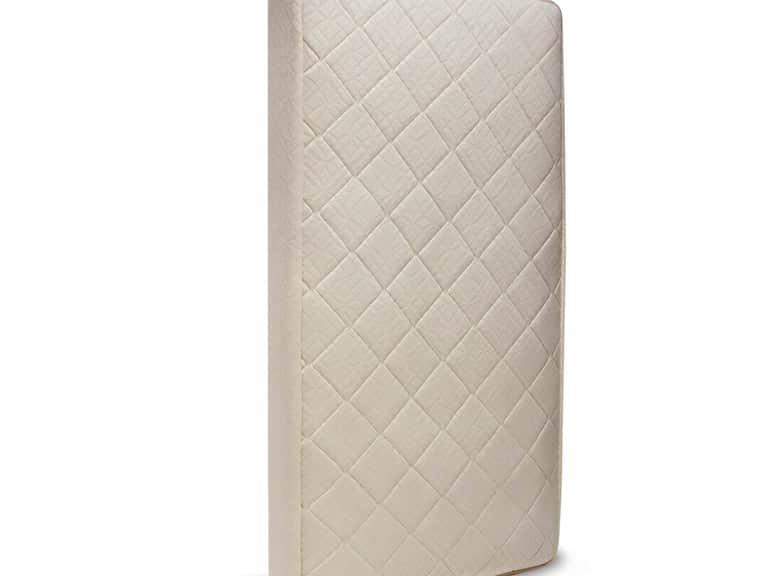
For many families, the relevant bedding item is a fitted crib sheet made for the specific mattress. If a product is described as a mattress pad, protector, moisture pad, or topper, read its purpose and instructions carefully rather than treating all such products as interchangeable. A product marketed for adult beds—or for a different type of crib mattress—should not be assumed to be suitable for an infant’s sleep space.
Fit: a small margin for error
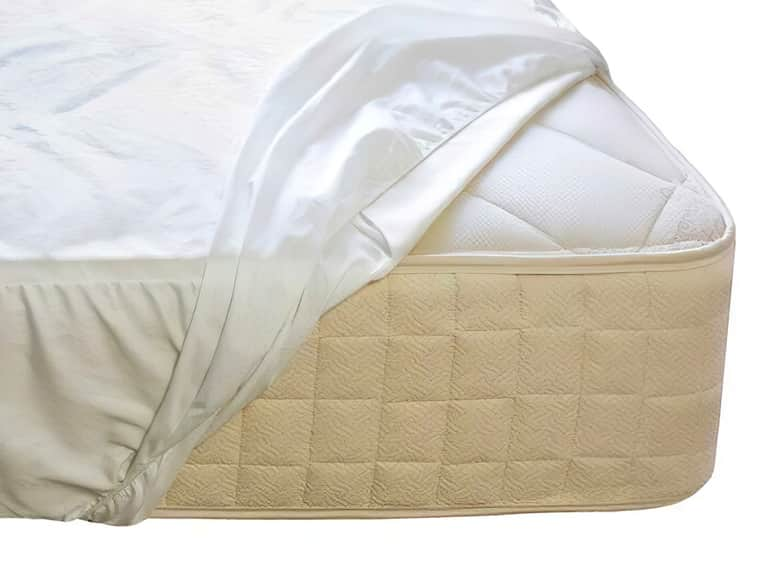
Good crib bedding should fit as the product and crib manufacturers specify. A fitted sheet is intended to stay taut over the mattress, with its edges fully secured beneath it. Loose fabric, a corner that repeatedly slips free, or elastic that no longer holds should prompt a closer look. Do not try to solve a poor fit by adding clips, ties, pins, or other improvised fasteners; these can create hazards and may conflict with product instructions.
Start with measurements, but do not rely on measurements alone. Check the mattress label and the crib manual for the mattress dimensions and the permitted thickness or height. Then compare those details with the sheet’s stated size and depth. “Standard crib” is a helpful description, not a guarantee that every product will fit every mattress. A mattress may have a different profile, and a sheet may shrink, stretch, or sit differently after laundering.
Before the first use, inspect the sheet in daylight. Stretch each corner over the mattress and check that it remains secure when the fabric is gently tugged. The sheet should not balloon, wrinkle into thick folds, or expose the mattress because it is too small. If the product’s instructions call for washing before use, follow them and check the fit again afterward. Cotton can change dimensions in laundering, particularly when exposed to excessive heat.
Fit also includes the surrounding furniture. Use the mattress only with the crib for which it was designed, and follow the crib maker’s directions about mattress placement and height. Do not add another layer beneath the sheet to compensate for an uneven surface or to make the mattress “fit better.” If a mattress seems loose, does not sit as intended, or leaves a concerning gap, pause use and contact the manufacturer for advice. Caregivers should not modify the crib or mattress to make incompatible pieces work together.
- Confirm that the mattress and fitted sheet are intended for the same type and size of crib.
- Check the mattress thickness or depth against the sheet’s stated limits.
- Read the crib and mattress manuals, especially instructions about approved accessories.
- After washing, check that every corner remains secure and the fabric lies smooth.
- Replace a sheet with damaged elastic, torn seams, holes, or persistent poor fit.
What “breathable” does—and does not—tell you
Breathability is an appealing word in bedding descriptions. It may refer to the way a fabric allows air or water vapor to pass through, or to a construction intended to feel less clammy. But the term can be used broadly, and it does not replace safe-sleep practices. A breathable fabric does not make loose bedding safe, and it does not make an added mattress layer appropriate for an infant. Nor should a marketing claim be taken to mean that a baby can sleep in any position or on any surface.
Natural fibers such as cotton are widely used in bedding and can feel comfortable against the skin. Organic cotton is cotton grown and processed under defined standards when supported by the relevant certification. The fiber’s origin, weave, weight, and finishing can all affect how a particular sheet feels and behaves. Two sheets made from cotton can differ substantially in softness, drying time, stretch, and durability. A label naming a fiber tells only part of the story.
Waterproof layers require particular attention. Some protectors use a barrier intended to keep liquid from reaching the mattress; their construction may affect the feel of the surface and the care routine. Product descriptions can use “breathable” for a barrier that permits some vapor movement while blocking liquid, but this claim should be read in the context of the product’s instructions and intended use. For a crib, caregivers should verify that any proposed protector is explicitly suitable for the specific infant mattress and is permitted by the mattress and crib manufacturers and current safe-sleep guidance. If that cannot be established, do not assume that it belongs in the sleep space.
Likewise, an organic certification and a safety certification answer different questions. A textile certification may address how a fiber was grown, processed, or tested for certain substances; it is not necessarily a test of a complete crib product’s fit or suitability for infant sleep. Read the exact name of a certification and the claim it supports. Broad phrases such as “natural,” “non-toxic,” or “chemical-free” are not substitutes for clear labeling, instructions, and appropriate standards.
Babies cannot reliably adjust their sleep environment or tell a caregiver that they are too warm. Keep the room and clothing appropriate to the conditions, and avoid adding blankets or extra bedding as a temperature fix. If a caregiver is unsure about overheating, clothing, or a medical condition affecting sleep, a pediatric professional can offer advice tailored to the child.
Washability: the quiet work of care
Washability is less glamorous than fiber origin, but it may determine whether bedding remains useful in everyday life. Infants make ordinary messes: milk, drool, diaper leaks, and the occasional spill that arrives just after a fresh sheet has been fitted. A practical sheet is one whose care instructions a household can follow consistently and whose fabric holds up to repeated laundering.
Before washing, read the label on the product itself. The instructions may specify water temperature, cycle, detergent, drying method, and whether bleach or fabric softener should be avoided. Follow those directions rather than applying a general rule to every organic textile. Some products may be machine washable but require a gentle cycle or low heat; others may have special instructions because of their construction or backing. A waterproof layer, when present, can be especially sensitive to heat or harsh treatments.
Use detergent appropriate for the fabric and the household, and rinse thoroughly if the care label recommends it. Avoid adding fragrances or fabric treatments simply to make bedding smell stronger. Fabric softeners and dryer sheets can affect some materials and are unnecessary for cleanliness. If a sheet is heavily soiled, the label’s instructions should guide whether it needs a particular wash or pre-treatment. Never mix cleaning chemicals or use a stronger treatment than the manufacturer permits.
Drying matters as much as washing. High heat can contribute to shrinkage, weaken elastic, or damage a coating. Line drying may take longer but can be a useful option where permitted; tumble drying should follow the label’s temperature guidance. Make sure the item is fully dry before placing it back on the mattress. Damp bedding can be uncomfortable and may invite odor or mildew during storage.
Keeping a spare fitted sheet can make changes less stressful, especially overnight. Store clean bedding in a dry place, and inspect it periodically for thinning fabric, stretched corners, broken seams, or lingering stains that do not come out with appropriate laundering. A sheet does not need to look new forever, but it should remain intact, clean, and properly fitted. Retire it when it no longer meets those conditions.
- Read the care label before the first wash, including any instructions for pre-washing.
- Use the recommended cycle and temperature; do not assume hotter water is always better.
- Avoid bleach, softener, or high-heat drying unless the label explicitly allows them.
- Dry completely and check the elastic, seams, and fit before returning the sheet to the crib.
- Keep a clean spare available so a soiled sheet can be changed promptly.
How to read an organic label
Organic claims can be useful when they are specific. Look for the name of the fiber, the part of the product the claim covers, and the certification or standard behind it. A product may have an organic cotton cover but a different filling, backing, elastic, or thread. That is not necessarily a problem, but the distinction should be clear. “Made with organic cotton” and “made entirely from organic materials” are different statements.
Certification is also not the same as a promise that a product will prevent allergies, improve sleep, or eliminate exposure to every substance. Such claims should be treated cautiously. An infant may have an individual sensitivity that cannot be predicted from a label, and organic materials can still require laundering and care. Choose bedding that is clearly labeled, appropriately certified where relevant, and compatible with the sleep setup—not simply the one with the most reassuring adjectives.
When product information is incomplete, ask the manufacturer precise questions: What are the dimensions? Is the item intended for infant use? Does it fit this mattress model and thickness? What materials make up each layer? How should it be washed and dried? Are there restrictions on using it with the crib or mattress? A clear answer is more useful than a broad claim of universal compatibility.
A simple decision process for caregivers
In the middle of a busy shopping list, choosing crib bedding can feel like a referendum on every possible concern. It need not be. A short sequence of checks can bring the decision back to what matters.
- Check the basics: Use a crib and mattress intended for infant sleep, assembled and maintained according to their manufacturers’ instructions.
- Choose a fitted sheet: Confirm its dimensions and depth, and make sure it is designed for the specific mattress type.
- Read the whole label: Identify the fibers, certifications, care instructions, and any stated restrictions.
- Keep the sleep space clear: Do not add quilts, loose blankets, pillows, bumpers, toys, positioners, toppers, or other soft accessories unless current guidance and a qualified professional specifically direct otherwise.
- Test the fit after washing: Check that the sheet is secure, smooth, and undamaged every time it goes back on the mattress.
- Ask when uncertain: Consult the crib or mattress manufacturer and the child’s healthcare professional rather than improvising.
This sequence does not make every decision effortless. Labels can be confusing, mattress profiles vary, and products are sometimes described in language that blurs the line between a sheet, a pad, and a protector. But a careful reading can prevent an accessory designed for comfort or protection in an adult bed from being mistaken for a suitable infant product.
The useful simplicity of a clear crib
There is an understandable wish to make a baby’s bed soft, welcoming, and complete. Yet a crib is not improved by accumulating layers. Its order is quieter: a properly fitted sheet over an appropriate mattress, a clear sleep space, and bedding that can be cleaned and checked without guesswork. The aesthetic may be spare. The care it represents is not.
Organic crib bedding can be a reasonable preference for families who value particular fibers or production standards. The most useful choice, however, is one that fits, is plainly labeled, can be maintained as directed, and does not invite additions that conflict with safe-sleep guidance. Breathability claims deserve scrutiny; washability deserves practical attention; fit deserves a fresh check after laundering.
In the end, the best bedding decision may be the one that asks the least of a caregiver at two in the morning: a sheet that stays in place, a spare close at hand, and no ambiguity about what belongs in the crib. That is a modest standard, but in infant care, modest standards—clear, repeatable, and carefully observed—are often the ones that matter most.